
Charlotte Warrant Checks
The paper you already hold points the way. A Charlotte warrant check starts with the citation rather than a guess at the office. A police desk cannot recall a court order, and a payment window cannot confirm a bench warrant. The wrong counter costs you a trip.
- Read the citation or notice for an office name and a case or citation number.
- Call the Charlotte Police Department at 517-543-1552 if the matter began as a city incident.
- Call the 56A District Court traffic window at 517-543-3359 or the criminal counter at 517-543-4029.
- Call the Circuit Court Clerk at 517-543-4335 for a felony after bindover.
- Call the Sheriff's warrant line at 517-543-7500, ext. 4026 if you still do not know the court.
- Bring photo identification in person, and write down the next date you are given.
Charlotte Warrant Questions: City Hall or Court
Charlotte Police answer at 111 E. Lawrence Ave. The courthouse and the sheriff's headquarters sit on Independence Boulevard, a short drive away. Two addresses, two record sets, two jobs. The city keeps police reports, citations, and ordinance records. The courthouse keeps the court file that says whether a warrant exists and whether a judge has recalled it. You can walk into either one. Only the courthouse controls that answer, though, so that is where a Charlotte warrant question lands. Note: In Charlotte a familiar building is not the right counter, so ask for the office name before you ask for a record.
Policing and Courts in Charlotte
Charlotte runs a full-service municipal police department. It has no criminal municipal court of its own. Ordinance enforcement stays with the city, while court process sits with the Eaton County trial courts. A case can start at one counter and finish at the other.
Charlotte Police Department
111 E. Lawrence Ave., Charlotte, MI 48813
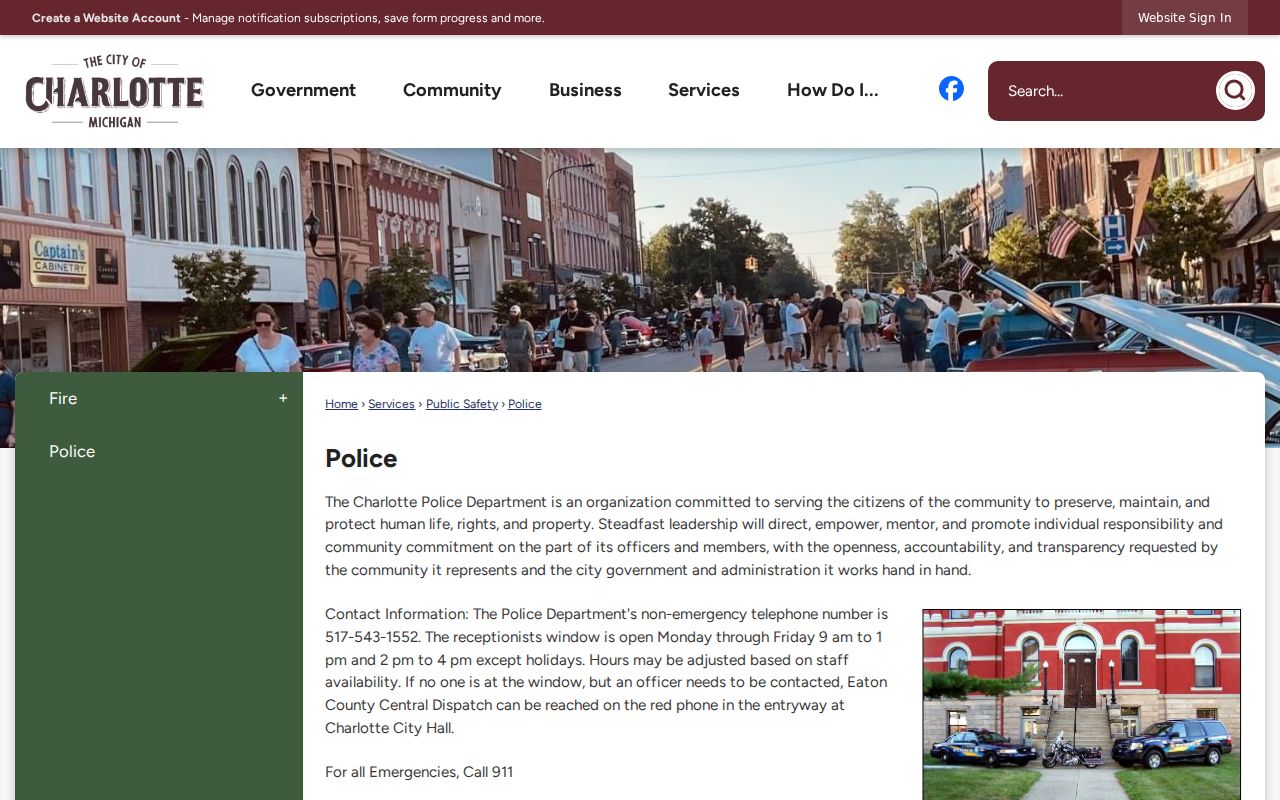
Nonemergency: 517-543-1552. Front window weekdays, with a red phone to Eaton Central Dispatch when the desk is closed.
56A District Court
1045 Independence Blvd., Charlotte, MI 48813
Court: 517-543-7520. Traffic counter: 517-543-3359. Criminal counter: 517-543-4029.
Charlotte Ordinance Cases and Warrant Records
Charlotte's ordinance keeps two tracks side by side. Some municipal civil infractions go through a city violation bureau. The city collects those payments directly. State citations and legal actions go to the Eaton County trial courts instead. The difference decides who can help you in Charlotte. A violation bureau can take a payment and close a municipal ticket, but it cannot recall a warrant held by a district or circuit judge.
Warrants in Charlotte: The Main Types
Four groups cover most Charlotte matters that end in a warrant. Each group has a different first stop.
| Warrant Type | How It Arises | Who Handles It |
|---|---|---|
| Traffic or civil-infraction warrant | An unpaid citation or a missed traffic date | 56A District Court |
| Ordinance matter | An unresolved city civil infraction | City violation bureau, then 56A if it becomes a legal action |
| Bench warrant | A missed court appearance or release condition | The court that set the appearance |
| Arrest warrant | A complaint filed after a Charlotte Police investigation | Court authorization; service by police or sheriff |
Charlotte Police Records and Warrant Status
A police report and a warrant status are different products in Charlotte. A report describes what an officer saw or did. A status describes what a court ordered. It also says whether the order still stands. Charlotte's FOIA page lays out the city request route, which covers reports, photographs, and recorded media under a five-business-day response target with a possible extension.
A report may mention a warrant in a Charlotte case and still not show today's status.
Charlotte Warrant Records: What They Show
A Charlotte warrant file reads like any other Michigan court record. Check the case number and issuing court first.
| Case or Citation Number | The identifier the clerk needs, shown in formats such as 25-001234-AR |
|---|---|
| Issuing Court | 56A District Court before bindover, or the 56th Circuit Court after |
| Charge or Ordinance | The citation, city ordinance, or criminal charge behind the process |
| Scheduled Appearance | The date that was missed or the next date the court has set |
| Bond or Release Terms | Conditions set at arraignment, where the court set any |
| Status | Open, served, recalled, or closed as shown in the court file |
Charlotte Warrant Calls and the Red Phone Route
Charlotte's police window keeps set hours on weekdays. It closes for holidays. When nobody is at the desk, the city points to a red phone in the City Hall entryway. It rings Eaton Central Dispatch. A dispatcher answers, not a records clerk. Use it to report something that needs an officer, not to ask about a Charlotte case file.
Missed Court in Charlotte: Warrant Steps
What you missed decides the building. A missed traffic or misdemeanor date belongs at the courthouse in Charlotte, while a missed payment on a city ticket belongs with the city first.
- Find the case or citation number on the notice.
- Check whether the paper says violation bureau or district court.
- Call the office named on the paper during public hours.
- Ask whether the court wants payment, a personal appearance, or both.
- Bring photo identification and the notice to any in-person visit.
Note: In Charlotte, as across Eaton County, a failure-to-pay warrant and a failure-to-appear warrant take different routes, so ask which one the court recorded.
Charlotte Warrants and Eaton County
A Charlotte warrant is not confined to Charlotte. The sheriff can serve one anywhere in Eaton County, and a city charge can move into the county court system.
Warrant flow: Charlotte Police / City Violation Bureau › 56A District Court › 56th Circuit Court after bindover › Eaton County Sheriff service
The county level has its own tools. The Eaton County warrant records overview explains the sheriff's warrant line and what the statewide systems do and do not show for Charlotte cases.
Accessing Charlotte Warrant Records
City and court records follow different access rules in Charlotte. A police report runs through the city FOIA coordinator. A court file runs through the clerk under the Michigan court-records rule, and neither route produces a live list of people with warrants.
Key Rules:
Michigan Freedom of Information Act, MCL 15.231: written request to the office that holds the record, with a response target of five business days.
Michigan Court Rule 8.119: court records are open to inspection unless a statute, rule, or order restricts them.
MCL 712A.28: juvenile records stay confidential, so a family matter does not follow the adult request route.
Charlotte Felony Warrants and the Circuit Clerk
A felony can start with a Charlotte Police investigation. It opens in district court, where a magistrate reviews probable cause and an arraignment sets bond. If the case survives a preliminary examination, it is bound over. The file then moves. After bindover the record belongs to the Circuit Court Clerk. The district court counter is the wrong place after that. A release violation at this stage can create a new Charlotte warrant without any new charge.